
 Back
Back


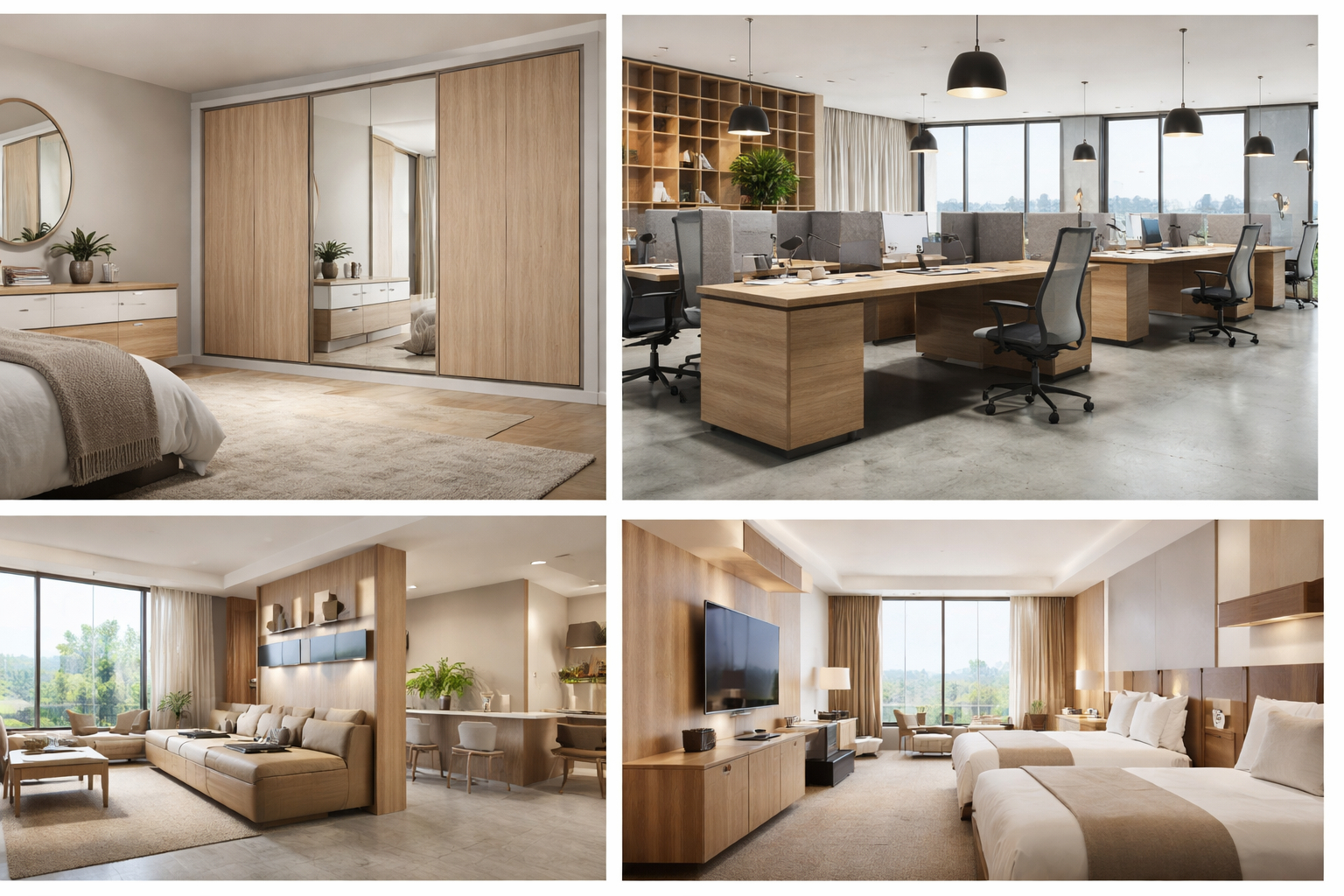
Modern interior design calls for materials that offer visual appeal, performance, and cost efficiency, without compromising on quality or sustainability. That explains the reason why particle board furniture has gained significant popularity in recent times. Once perceived as a cheaper alternative to solid wood, particle board has transformed into a highly engineered, design-ready solution, perfectly suited for contemporary interiors. When manufactured using advanced processes and enhanced with melamine surfaces, particle board offers a compelling combination of strength, consistency, finish quality, and affordability. Leading particle board manufacturers and suppliers, such as Greenlam MFC, have played a key role in elevating this material to meet modern interior demands, making it a preferred choice for large-scale and design-driven furniture applications.
Particle board furniture is made using engineered wood panels produced from wood chips and wood residues that are bonded together with resins and compressed under controlled pressure. This process creates uniform, stable boards with predictable performance, making particle board a reliable material for contemporary furniture manufacturing.
Key characteristics of particle board include:
What significantly enhances the usability of particle board in furniture is its compatibility with decorative surface finishes, particularly melamine. When a particle board is surfaced with melamine, it becomes a ready-to-use furniture panel, eliminating the need for additional painting, polishing, or lamination.
This makes particle board furniture especially suitable for applications such as:
From a design and execution standpoint, particle board furniture supports precision manufacturing, faster installation, and consistent aesthetics, making it a practical choice for both residential and large-scale commercial interiors.
Read Also: An Introductory Guide to Particle Board Furniture
Particle board furniture offers a practical combination of performance, affordability, and design flexibility, making it a preferred choice for modern residential and commercial interiors. When enhanced with advanced surface technologies such as melamine-faced chipboard (MFC – Melamine Faced Chipboard), these benefits are further strengthened, enabling particle boards to meet the evolving demands of contemporary furniture applications. Key benefits include:
One of the most significant advantages of particle board furniture is the performance upgrade it receives when finished with melamine. Melamine faced particle boards are factory-finished, ready-to-use panels that eliminate the need for additional surface treatments.
Key performance benefits include:
These characteristics make melamine-faced particle boards particularly suitable for modular furniture and large-scale interior projects.
Particle board furniture supports a wide range of interior design styles due to the availability of decorative melamine finishes. This allows designers and manufacturers to achieve visual continuity across different furniture elements.
Design advantages include:
This level of consistency is especially valuable in wardrobes, cabinets, workstations, and storage systems where uniform appearance is essential.
One of the key reasons particle board furniture is widely adopted is its affordability without compromising on functionality. Its engineered nature supports efficient production at scale, making it ideal for both residential and commercial projects.
Cost-related benefits include:
This makes particle board furniture a smart choice for projects requiring consistency, speed, and budget control.
Despite being lightweight, particle board offers dependable strength for everyday furniture applications. Its structure supports efficient fabrication and installation, contributing to smoother project execution.
Additional advantages include:
From a sustainability perspective, particle board furniture supports responsible material use by efficiently utilising wood residues, reducing reliance on solid timber, and aligning with environmentally conscious interior practices.
Read Also: How to Choose and Check the Quality of Prelaminated Particle Boards
Greenlam MFC enhances the inherent benefits of particle board furniture through technology-driven manufacturing and strict quality control. Manufactured using advanced continuous press systems, Greenlam MFC boards deliver:
These attributes make Greenlam MFC’s melamine-faced particle boards well suited for diverse interior environments, including residential spaces, offices, retail interiors, healthcare facilities, and hospitality settings.
Choosing the right engineered wood for furniture depends on factors such as cost, finish quality, ease of fabrication, and suitability for modern interior applications. The comparison below highlights how particle board furniture performs against commonly used alternatives such as MDF and plywood.
|
Parameter |
Particle Board Furniture |
MDF |
Plywood |
|
Cost Efficiency |
Highly cost-effective for large-scale furniture and interiors |
Moderately expensive due to higher density |
More expensive due to layered construction |
|
Weight |
Lightweight and easy to handle |
Heavier and denser |
Heavier than particle board |
|
Surface Finish |
Smooth, uniform surface ideal for melamine finishes |
Requires additional finishing for decorative use |
Natural surface variations may need extra finishing |
|
Design Consistency |
High consistency across panels, ideal for modular furniture |
Consistent but heavier to work with |
Variations across sheets can affect uniformity |
|
Ease of Fabrication |
Easy to cut, drill, and edge-band |
Good machinability but higher tool wear |
Requires skilled handling and tooling |
|
Suitability for Furniture |
Ideal for wardrobes, cabinets, workstations, and modular systems |
Suitable for detailed profiles and painted furniture |
Better for structural or heavy-load applications |
|
Scalability for Projects |
Excellent for bulk furniture production |
Suitable but costlier at scale |
Less cost-efficient for large interior projects |
The versatility of particle board furniture makes it suitable for a wide range of interior environments. Its consistent quality, smooth finish, and cost efficiency allow it to adapt seamlessly to both residential and commercial applications, including spaces that demand durability, hygiene, and design uniformity. Applications include:
Particle board furniture is widely used in modern homes where modular design, clean finishes, and efficient space utilisation are priorities.
Common residential applications include:
Its compatibility with melamine surfaces ensures durable finishes that retain their appearance over time.
In commercial environments, furniture materials must support high usage while maintaining a cohesive visual identity. Particle board performs well in such settings due to its uniform structure and scalability.
Key applications include:
These qualities make particle board a preferred material for time-sensitive commercial projects.
Furniture used in healthcare and hospitality environments must balance durability, hygiene, and aesthetics. Particle board furniture meets these requirements when engineered and finished appropriately.
Typical applications include:
The availability of high-quality melamine finishes further enhances suitability for such specialised environments.
Read Also: MFC for Hospitality Spaces: A Brief Application Guide
Choosing the right particle board is essential to ensure long-lasting furniture performance, visual consistency, and smooth project execution. While particle board furniture offers several advantages, selecting the appropriate specification based on usage and environment makes a meaningful difference to the final outcome. Things to keep in mind when choosing the right particle board for your project include:
The first step is understanding where and how the furniture will be used. Thickness and density play a key role in determining strength and load-bearing capacity.
Key considerations include:
Matching board specifications to functional requirements ensures durability and structural reliability.
The surface finish directly affects both appearance and maintenance. Melamine-faced particle boards offer ready-to-use finishes that suit a wide range of interior styles.
When selecting finishes, consider:
Choosing the right finish helps achieve design continuity while meeting practical usage needs.
Furniture installed in high-use or moisture-prone environments requires enhanced performance characteristics.
It is important to:
This ensures furniture retains its appearance and functionality over time.
Beyond product specifications, the reliability of the supplier plays a crucial role in project success. Working with established particle board manufacturers and suppliers helps ensure:
Choosing a trusted manufacturer such as Greenlam MFC provides added confidence in both product performance and long-term project outcomes.
Selecting the right particle board manufacturer is as important as choosing the material itself. For furniture that demands consistent quality, design precision, and long-term performance, Greenlam MFC brings together advanced manufacturing, material expertise, and a deep understanding of modern interior requirements. Here’s why people trust Greenlam MFC for particle board furniture:
Greenlam MFC operates one of India’s most advanced integrated particle board manufacturing facilities, designed to deliver uniform board quality at scale. The use of modern continuous press technology ensures precise thickness control, consistent density, and reliable performance across every panel.
This level of manufacturing integration allows Greenlam MFC to meet the demands of large residential developments, commercial interiors, retail fit-outs, healthcare facilities, and hospitality projects, without variation in quality or finish.
Greenlam MFC specialises in melamine-faced particle boards that are engineered for both performance and aesthetics. These boards offer:
This makes Greenlam MFC boards particularly suitable for particle board furniture, where durability, finish uniformity, and precision fabrication are critical.
Read Also: Advantages of Melamine Faced Chipboard (MFC): Why It Has Become a Modern Furniture Essential
Beyond performance, Greenlam MFC supports design continuity through a wide range of contemporary finishes, including woodgrains, solids, and textures. This allows architects, designers, and furniture manufacturers to create cohesive interior themes across wardrobes, cabinets, workstations, and modular furniture systems.
The availability of coordinated designs ensures visual consistency across spaces – an essential requirement for modern interior projects.
As one of India’s trusted particle board manufacturers and suppliers, Greenlam MFC offers reliability beyond the product itself. A strong distribution network ensures timely availability of boards across regions, supporting seamless project execution and dependable supply for both small-scale and large-scale requirements.
This combination of manufacturing strength, product performance, design flexibility, and supply reliability positions Greenlam MFC as a preferred partner for high-quality particle board furniture solutions across India.
As interior spaces continue to evolve, the demand for furniture materials that balance cost efficiency, durability, and design flexibility is only set to grow. In this context, particle board furniture has emerged as a smart, modern solution, supporting everything from modular residential designs to large-scale commercial, retail, healthcare, and hospitality interiors.
When enhanced with melamine surfaces and manufactured using advanced technology, particle board delivers consistent performance, clean aesthetics, and reliable long-term use. Partnering with established particle board manufacturers and suppliers further ensures quality, scalability, and dependable execution.
With its advanced manufacturing capabilities, high-performance melamine-faced particle boards, and design-driven approach, Greenlam MFC is well positioned to support the next generation of interior projects. Whether the requirement is for wardrobes, office furniture, retail fit-outs, or specialised interior spaces, Greenlam MFC offers particle board solutions engineered for efficiency, reliability, and contemporary design needs.
Eco-friendly particle board furniture companies in India usually work with manufacturers that follow responsible sourcing and sustainable production practices. Particle board itself supports sustainability by utilising wood residues efficiently. Reputed manufacturers such as Greenlam MFC focus on controlled manufacturing processes and environmentally responsible material use, making them a preferred choice for sustainable interior projects.
Yes, melamine-faced particle board is highly durable when used for appropriate furniture applications. The melamine surface provides resistance to scratches, stains, and everyday wear, while the engineered particle board core offers consistent strength and stability. This makes it suitable for wardrobes, cabinets, workstations, and modular furniture used in both residential and commercial interiors.
The choice depends on the application. Particle board furniture is generally more cost-effective, lighter, and better suited for large-scale modular interiors with decorative melamine finishes. MDF may be preferred for intricate designs or painted finishes but can be heavier and more expensive for bulk furniture requirements. For modern interiors prioritising efficiency and uniformity, particle board is often the more practical option.
Particle board is not a replacement for solid wood in structural or heavy-load applications, but it performs exceptionally well for modern furniture where design consistency, affordability, and scalability are key. When enhanced with melamine finishes and manufactured using advanced technology, particle board furniture offers reliable performance for everyday interior use.
Particle boards offer several advantages, including cost efficiency, uniform surface quality, lightweight handling, and compatibility with decorative finishes. They also support faster furniture production and consistent aesthetics, making them ideal for modular furniture and large interior projects across residential and commercial spaces.
Particle boards are available in various forms based on performance requirements, including standard particle boards for dry areas and moisture-resistant variants for more demanding environments. Melamine faced particle boards are widely used for furniture as they combine structural reliability with ready-to-use decorative surfaces.
Quality particle boards can be sourced through authorised distributors of established particle board manufacturers and suppliers. Working with trusted brands such as Greenlam MFC ensures access to high-performance melamine particle boards, consistent supply, and products suited for a wide range of interior applications.